


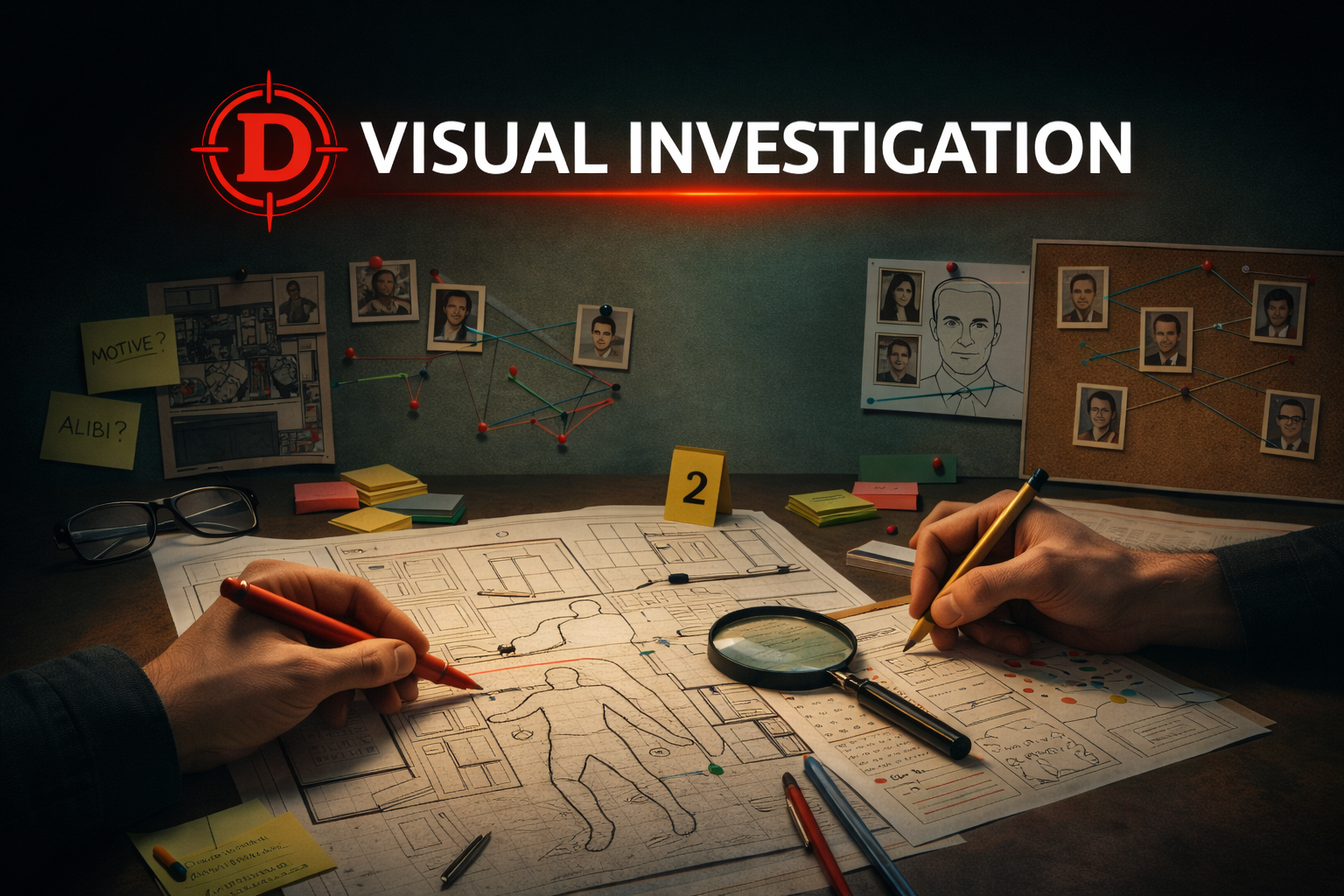
Why Observation Skills Matter in Investigation
Most people walk into a room and miss critical details. Discover how investigators train observation skills to analyze environments and identify hidden clues.
Observation is one of the most important skills in investigation. A trained investigator learns to notice details most people overlook the moment they enter a room.
How Investigators Train Their Eyes
Small clues often reveal important information about what happened in a space. The position of objects, patterns of movement, and subtle visual inconsistencies can all provide insights that help reconstruct events.
Professional investigators train their observation skills by practicing structured visual analysis. Instead of casually scanning a room, they document layouts, study spatial relationships, and identify unusual details that others may miss.
Developing observation skills takes practice. The more you train your eyes to analyze environments carefully, the better you become at identifying meaningful clues.
If you want to test your own observation skills, try the room observation challenge below.
These same observation techniques are taught step-by-step in the DIY Detective™ Visual Investigation training.
Next Investigation Technique
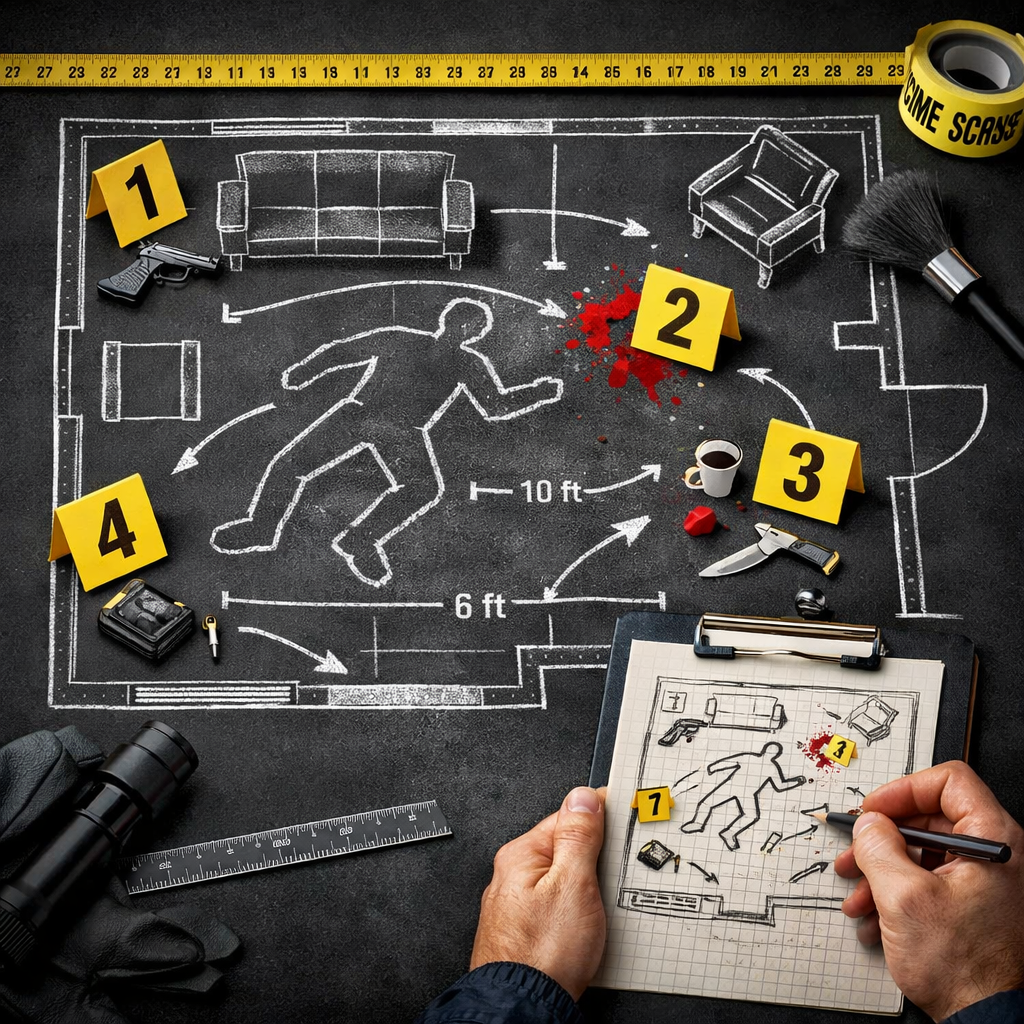
How Investigators Map Crime Scenes
Crime scene mapping helps investigators reconstruct events by documenting spatial relationships, object placement, and movement patterns. Learn how visual analysis helps reveal critical clues.
Crime scene mapping is one of the most important techniques investigators use to understand what happened in a physical space. By documenting the layout of a location and recording where evidence is found, investigators can begin reconstructing the sequence of events that occurred.
When investigators arrive at a scene, they do not rely on memory alone. Instead, they carefully record the spatial relationships between objects, evidence, and environmental features. This process allows them to create a visual record that can be studied long after the scene itself has changed.
Why Crime Scene Mapping Matters
Every object in a scene has a position, and that position can reveal important clues. The location of a piece of evidence, the distance between objects, and the orientation of items within a room can all provide insight into what occurred.
Mapping a scene helps investigators identify patterns that might otherwise be overlooked. When the layout of a scene is documented clearly, it becomes easier to analyze movement paths, points of entry, and interactions between individuals.
A well-constructed crime scene map can also help investigators explain complex situations to others. Detectives, prosecutors, analysts, and juries often rely on visual diagrams to understand how events unfolded.
How Investigators Document a Scene
Investigators typically begin by observing the entire environment before moving or collecting any evidence. They record the layout of the space and identify key reference points such as walls, doors, furniture, and other fixed objects.
Measurements are then taken to determine the distance between these reference points and pieces of evidence. These measurements help create a scaled diagram that accurately represents the scene.
Photographs, sketches, and notes are often used together to build a complete record. The goal is to preserve the scene visually so investigators can analyze it later with precision.
From Observation to Reconstruction
Once a crime scene map has been created, investigators use it to reconstruct what may have happened. By studying the placement of objects and the relationships between pieces of evidence, they can develop a clearer understanding of how events unfolded.
Crime scene mapping does not rely on speculation. Instead, it focuses on careful observation and structured documentation. When investigators combine accurate mapping with evidence analysis, they can uncover details that might otherwise remain hidden.
Learning Visual Investigation Skills
Mapping environments and documenting spatial relationships are skills that can be learned and practiced. Training the eye to observe details and record them clearly is an important part of investigative work.
These same visual investigation techniques are taught step-by-step in the DIY Detective™ Visual Investigation training.
Next Investigation Technique

How Detectives Build Suspect Network Maps
Detectives build suspect network maps to visualize relationships between individuals involved in complex investigations. Learn how visual mapping helps investigators uncover hidden connections and identify key figures within criminal networks.
In complex investigations, detectives often face a web of people, events, and connections that can be difficult to understand by reading reports alone. One of the most effective ways investigators organize this information is by creating suspect network maps.
A suspect network map visually shows how individuals are connected to one another within an investigation. By mapping relationships, detectives can begin to see patterns, identify central figures, and uncover hidden links that might otherwise remain unnoticed.
What Is a Suspect Network Map?
A suspect network map is a visual diagram that shows relationships between individuals involved in an investigation. These diagrams often include photographs, names, locations, events, and connections between people.
Investigators may use lines, colors, arrows, or labels to indicate different types of relationships such as communication, financial activity, shared locations, or involvement in the same events.
By placing individuals and connections into a visual structure, detectives can study the network as a whole rather than looking at isolated pieces of information.
Why Visual Mapping Helps Investigators
Human brains are better at recognizing patterns visually than through large amounts of written information. When detectives place information on a board or diagram, connections that once seemed unrelated may become obvious.
Network maps can reveal:
central figures within a group
communication patterns between individuals
clusters of people connected to the same activity
possible coordinators or intermediaries within a network
These insights help investigators focus their attention on the most important individuals or relationships within a case.
How Detectives Build Network Maps
Detectives begin by gathering information from many sources, including interviews, records, surveillance reports, and digital evidence. Each piece of information may introduce new individuals or connections.
Investigators then begin organizing this information visually. Photographs, names, and notes are placed on a board or diagram. Lines or colored markers may be used to show relationships or interactions.
As more information becomes available, the network map evolves. New connections are added, relationships are clarified, and the structure of the network becomes easier to understand.
From Simple Drawings to Investigative Frameworks
Many investigators begin this process with simple tools. A sheet of paper, a notebook, markers, or even crayons can be used to sketch the first version of a suspect network map.
Drawing relationships between people allows investigators to slow down, examine the details, and think through how events may be connected.
Over time, these simple sketches develop into more detailed investigative diagrams that help document relationships and support further analysis.
Learning to Visualize Investigations
Suspect network mapping is one of many visual investigation techniques used by detectives to organize complex information. Learning how to document relationships and analyze connections can help investigators uncover patterns that might otherwise remain hidden.
These same visual investigation techniques are taught step-by-step in the DIY Detective™ Visual Investigation training.
Next Investigation Technique
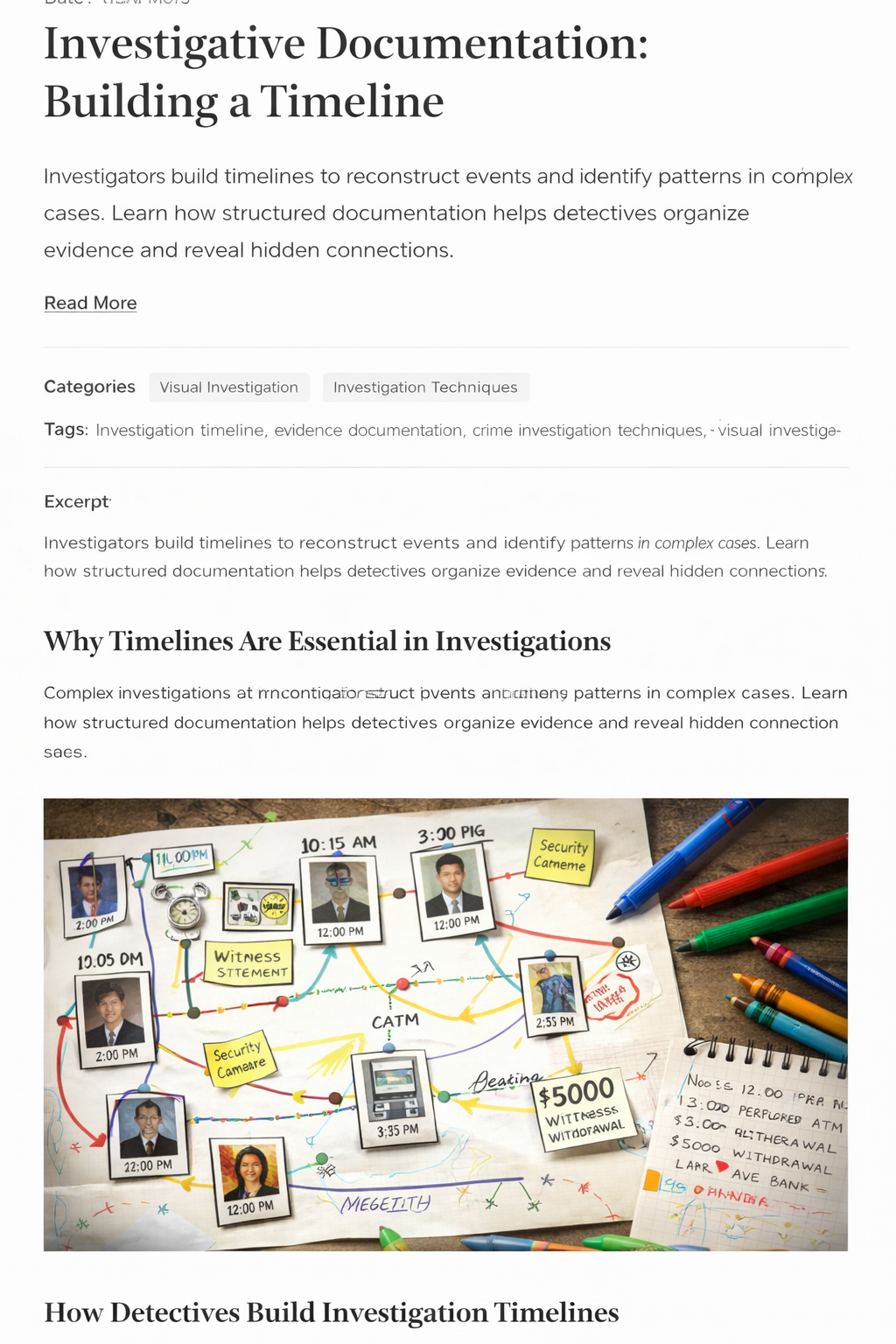
Investigative Documentation: Building a Timeline
Investigators build timelines to reconstruct events and identify patterns in complex cases. Learn how structured documentation helps detectives organize evidence and reveal hidden connections.
In complex investigations, understanding what happened often begins with one fundamental question: what happened first?
Investigators rely on timelines to organize events, track actions, and understand how situations unfolded over time. By arranging information chronologically, detectives can transform scattered pieces of evidence into a structured narrative.
A timeline allows investigators to see relationships between events that might otherwise appear unrelated.
Why Timelines Are Essential in Investigations
Criminal investigations often involve multiple people, locations, and events occurring at different times. Without a clear timeline, it can be difficult to determine how those elements connect.
When investigators document events in chronological order, patterns begin to emerge. Timelines can reveal:
sequences of actions leading up to an event
overlapping activities between individuals
gaps in information that require further investigation
inconsistencies in statements or reports
By visualizing time itself, investigators gain a clearer understanding of the case.
How Detectives Build Investigation Timelines
Building a timeline usually begins with collecting every known event related to a case. Investigators review reports, interviews, communications, and records to identify key moments that can be placed in chronological order.
Each event is then documented with details such as:
date and time
location
individuals involved
evidence connected to the event
As the timeline grows, investigators can examine how events relate to one another and identify which moments are most important to the investigation.
Visual Documentation as an Investigative Tool
Many investigators begin timeline construction using simple visual tools. A notebook, paper, markers, or even crayons can be used to sketch the first version of an investigative timeline.
Drawing events and connections helps investigators slow down and carefully consider how information fits together.
Over time, these sketches evolve into structured investigative records that can support deeper analysis.
From Timeline to Investigation Strategy
Once a timeline is constructed, investigators can begin asking new questions. Why did certain events occur when they did? Who was present at key moments? What actions triggered the events that followed?
By studying the sequence of events, detectives can focus their investigation more effectively and identify the most significant leads.
Timelines do not solve cases by themselves, but they provide a powerful framework for understanding how complex situations develop.
Learning Investigative Documentation Techniques
Building timelines, mapping relationships, and documenting evidence are core visual investigation skills. These methods allow investigators to organize information clearly and analyze complex cases more effectively.
These same investigative documentation techniques are taught step-by-step in the DIY Detective™ Visual Investigation training.